

The Council planning session had already been underway for more than an hour when the Council President moved to the next item on the agenda.
All Arc directors were present, along with the sitting Council members, the Captain, and the First Officer.
Kyla sat beside Council Member Adeyemi, reviewing the notes in front of her. Since becoming Sheila’s assistant after the election, Kyla had taken on more of the research and preparation behind each Council session.
Adrian Vale sat several places away, reviewing something in his own notes with the patience of a man who had already read it twice.
Liam had been transferred to the Navigation Arc after being recommended by Adrian. He was sitting next to the Captain, serving as his assistant.
The President looked down at her agenda.
“The next item concerns a report submitted by the Forge Arc last month regarding non-manufacturable components.”
The chamber panels changed.
A diagram of a Whisperzend appeared, separated into layers. Kyla recognized the curved pads and the thin arms that extended toward the temples. The next image showed what was inside.
“The Forge Arc has identified several systems that depend on components we can repair and refurbish but cannot manufacture aboard Helios,” the President continued. “The immediate concern brought to the Council involves Whisperzends.”
She looked toward the Forge Arc director.
“Director.”
The director stood.
“Most of the physical components used in a Whisperzend can be manufactured aboard Helios,” he said. “The housing, contacts, wiring, and several other components can be replaced as needed.”
Several parts of the diagram turned gray.
A small section of the circuitry remained highlighted.
“These cannot.”
Kyla leaned forward slightly.
“The circuitry contains components that require manufacturing processes Helios does not possess. Every functional board aboard the ship ultimately comes from the inventory launched from Earth, or from another device that has been recovered and refurbished.”
The diagram disappeared.
Numbers replaced it.
The director paused.
“The problem is that our recovery rate has been declining.”
A projection appeared across the center panel. Kyla followed the line as it moved gradually downward.
“Based on current failure rates and the number of children approaching eligibility, we estimate that within eight years we will no longer have enough serviceable Whisperzends to maintain the current allocation policy.”
Kyla looked toward Sheila.
Sheila was staring at the projection.
The President asked, “To be clear, what happens in eight years?”
“We cannot predict the exact day yet,” the director replied. “But under current projections, there will come a point when the number of serviceable devices available for reassignment is lower than the number required.”
“For replacements?” the Captain asked.
“For replacements and new allocations.”
The director changed the display again.
“Under current policy, every citizen receives a personal Whisperzend at age twelve.”
The director paused.
“The concern is that approximately eight years from now, we may not be able to provide one to every child reaching that age.”
The room became quieter.
The President thanked the director, and he returned to his seat.
“The purpose of this discussion is to determine what options the Council should evaluate before the projected shortage occurs,” said the President.
The Captain leaned toward his microphone. “I’m more concerned about the circuitry used in devices and equipment that provide life support and other vital functions. Do we have projections for those?”
The Forge Arc director answered. “The initial inventory of non-manufacturable components was calculated to last well beyond arrival. The problem with the Whisperzend devices is that their failure rate appears to have been underestimated. We have also lost several devices due to accidents, the most recent approximately a year ago.”
Adrian leaned toward his microphone.
“Perhaps we should start by reconsidering the allocation model.”
The President looked toward him.
“Go ahead, Council Member Vale.”
“Whisperzends are assigned at age twelve and, in practice, remain assigned for life,” Adrian said. “Perhaps we should incentivize people to return them earlier.”
“What are you suggesting?” the President asked.
“An allocation system using ledger credits.”
There was a brief silence.
Adrian continued.
“We already use ledger credits to manage access to limited resources. Cabin allocations are one example. Whisperzends could operate under a similar model.”
“You want people to pay for their Whisperzend?” Sheila asked.
“I want people to make a choice about whether they need one.”
Adrian folded his hands on the table.
“People who want continuous personal access would pay a monthly charge. The amount could be adjusted according to inventory and demand.”
Sheila shook her head.
“Whisperzends are how people communicate. Students use them for school. We use them to access the Computer and Logminter. People record their lives with them.”
“And none of those things requires a Whisperzend,” Adrian replied.
Sheila stopped.
Adrian continued.
“Logminter can be accessed from shared devices. So can Computer services. Messages can be sent from terminals. Children already do those things before they receive their first Whisperzend.”
Sheila turned toward Director Prescott.
“Director, how many log entries are recorded aboard Helios in a year?”
Prescott did not need to retrieve it.
“Roughly six hundred thousand.”
“And what fraction are recorded through a Whisperzend?”
Director Prescott paused to check the Data and Information Office records.
“Approximately eighty-two percent.”
“Then this is not a question about convenience,” Sheila said. “A system that depends on charging ledger credits will reduce the number of records from people who earn fewer credits. It will not reduce them evenly across the population.”
“I think that’s enough,” the President said.
The chamber became quiet.
“We have an engineering problem and one possible response to it. We do not yet have a proposal.”
She looked first toward Adrian and then toward Sheila.
“I don’t intend to have the Council debate a policy that hasn’t been written.”
She glanced around the chamber.
“If Council Member Vale wishes to develop a model based on ledger credits, submit it for review.”
Adrian nodded.
The President turned toward Sheila.
“And if anyone believes there is a better way to extend the Whisperzend inventory, prepare an alternative.”
Sheila nodded slowly.
“I will.”
“Good.”
The President returned to the agenda.
“Formal proposals will be reviewed two weeks from today. The Forge Arc will provide the projections necessary to evaluate them.”
The panels changed again, and the Whisperzend disappeared.
The President moved to the next item.
Kyla tried to follow.
Instead, she kept thinking about the line on the projection.
Eight years.
Her hand had moved to her stomach.
Subscribe to receive new posts.
###
The Plaza was busy in the way it always was after the working shifts ended. Children ran along the edge of the shallow basin while the blue light pulsed underneath them in slow waves.
Kyla and Julian sat on one of the benches near the basin.
The kiosk had watermelon ice pops. Julian had bought two, handing one to Kyla before she could ask.
“Eight years,” Kyla said quietly.
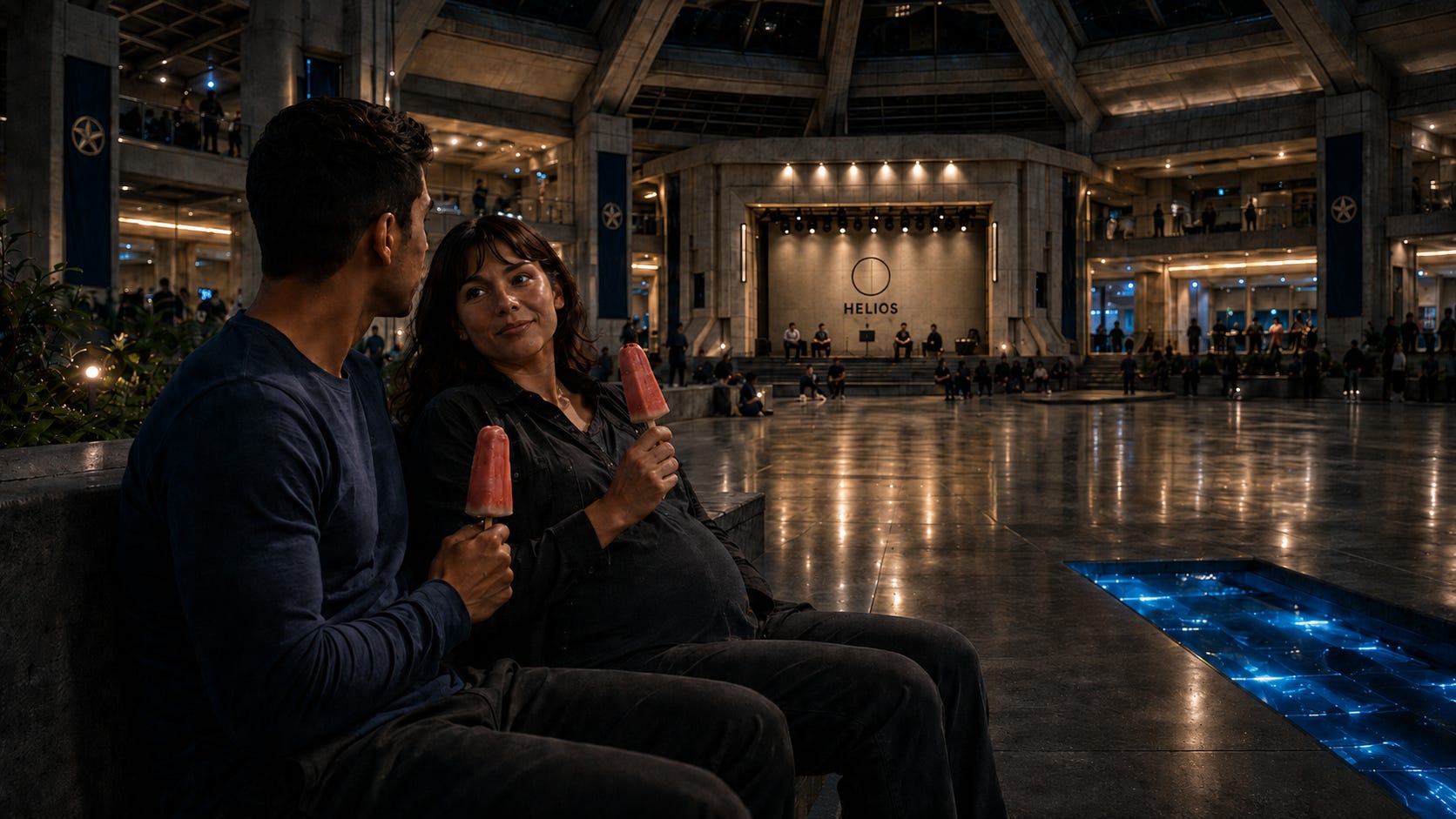
Julian glanced at her. “You’re still thinking about the meeting.”
“Of course I am. Do you remember getting yours?”
“Barely.”
“I do. I counted the days.”
Julian smiled. “That sounds like you.”
Kyla nudged him with her shoulder.
“It felt like freedom. I could whisper anyone whenever I wanted. I could talk to Logminter without having to find a terminal.”
She looked down at what remained of her ice pop.
“Alex may not get one.”
“Yes, he will,” Julian said. “He’ll be okay.”
Kyla watched two children race across the bridge.
“I don’t like Adrian’s idea.”
“I figured,” Julian said.
Kyla continued.
“The argument is that price makes people choose, but it doesn’t. It chooses for them, and it always chooses the same people.”
Julian took another bite of his ice pop.
“So what would you do?”
“I don’t know,” Kyla admitted.
The two children disappeared into one of the corridors.
“Maybe we’re giving them out too early.”
“At twelve?” Julian asked.
“Maybe thirteen. Fourteen. I don’t know.” Kyla shrugged. “Children already use terminals before they get one.”
“And maybe people shouldn’t keep them for the rest of their lives.”
Julian turned toward her.
“You mean give them back?”
“At some point.”
“That would affect our parents,” Julian said.
“I know.”
“And eventually us,” he added.
Kyla looked at him.
“I know that too. But it would be more equitable.”
Julian was quiet for a moment.
Kyla glanced toward the corridor where the children had disappeared.
“Sheila wants to bring an alternative proposal to the Council, so we have two weeks to come up with something better.”
Thanks for reading Kyla’s Diary, a novel from the Theogenic Universe. New chapters will be published weekly. Subscribe to continue the journey aboard Helios.