

The Civic Arc conference room was small. A rectangular table occupied most of the space. One wall held a display panel. Another one had a small window facing the corridor.
A half-finished pot of dandelion coffee was at the center of the table, surrounded by notes.
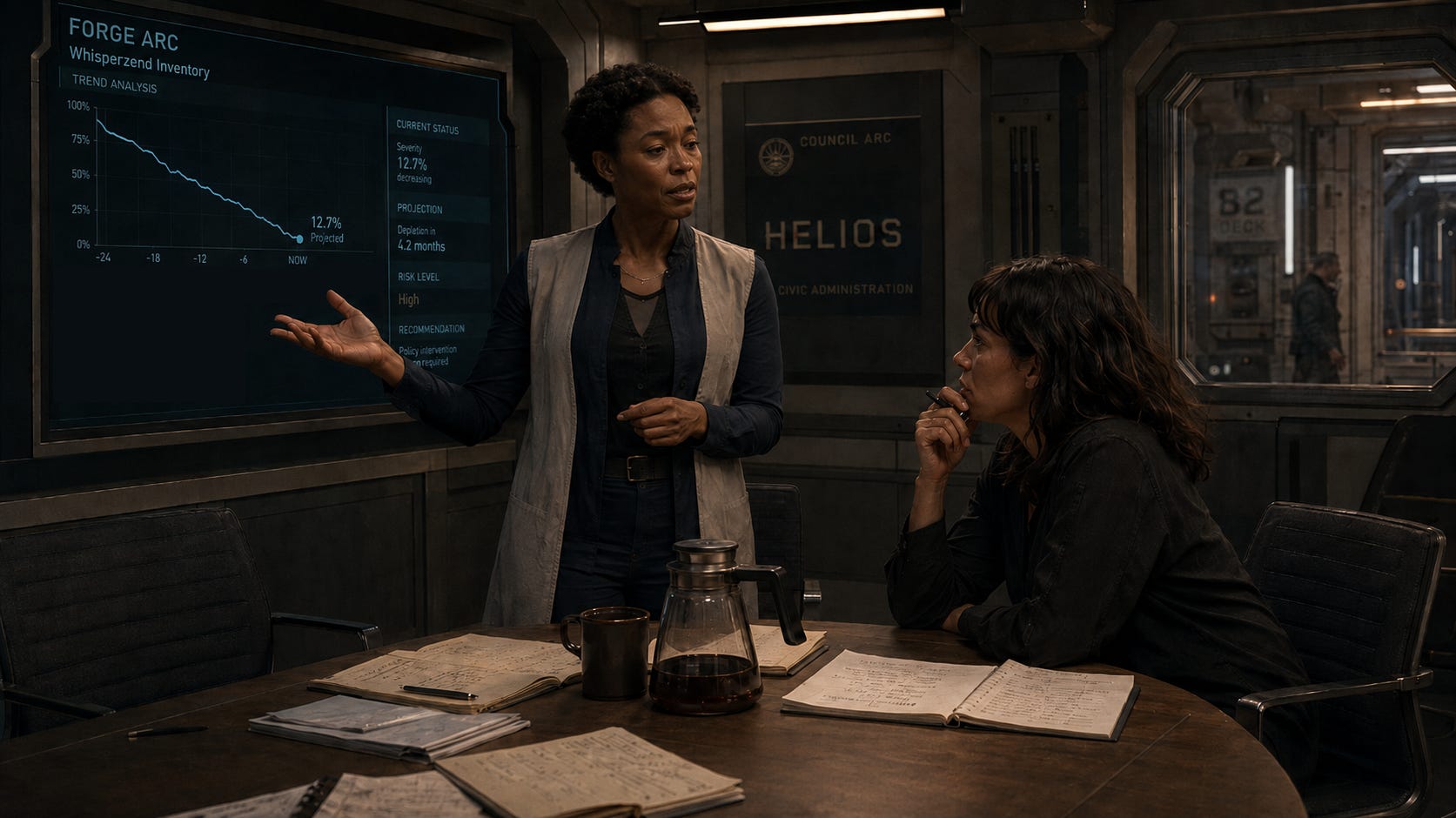
Sheila stood beside the display. The Forge Arc projection was already up on the panel. The same descending line from the Council session showing the decline in Whisperzends.
“Sixteen?” Sheila asked.
Kyla looked up from the table.
“Sixteen years old instead of twelve will make it work.”
Sheila crossed her arms.
“I know sixteen would be better, but waiting four more years may be too much to ask. They will be ready to start the cadet program without any experience using a Whisperzend.”
“You’re right. Fourteen is a good compromise, but we have to reduce the age to return the devices to seventy-four,” Kyla said.
Sheila reduced the upper end of the age distribution.
Kyla studied the numbers.
“It helps, but if we want a lasting solution, we need to set it even lower. Like sixty-four years old.”
“That will be political suicide,” Sheila said. “It will not have enough votes.”
She looked back at the projection.
“Seventy-four is easier to defend.”
“It is,” Kyla said. “But it only postpones the shortage.”
Sheila did not answer.
Kyla adjusted the model again.
“At sixty-four, the projection stays within the available inventory.”
“For how long?” Sheila asked.
“Long enough to get us through the current shortage projection.”
Sheila pulled out a chair and sat across from Kyla.
For a moment, neither spoke.
Kyla looked at the projections again.
“When I was twelve, getting my Whisperzend felt like freedom.”
Sheila nodded.
“You could whisper someone from anywhere. Talk to Logminter while walking. Record something the moment you thought of it.”
Kyla looked back at the age distribution.
“Starting at fourteen is the right call.”
“Yes, let’s do fourteen,” Sheila said. “But returning the device while still actively working would probably feel like losing a lot.”
“We could add an exemption when continuous access is required by an active operational role,” Kyla said.
Sheila thought for a moment.
“Yes, let’s add that exemption.”
Kyla entered the sentence.
The draft filled the display.
Sheila read the proposal from beginning to end.
“I think this is it,” she said. “We’re not asking the sacrifice to belong to one group.”
Kyla looked at the two numbers.
14 and 64.
“Fifty years,” she said. “My parents will have to use a terminal soon, and Alex would have to wait two more years, but I think this is defensible.”
“Yes, it is defensible,” Sheila said. “And it offers a better option than having access based on what a person can afford.”
She sat back.
“I still don’t like sixty-four.”
“Neither do I.”
Kyla looked for the exemption and read it again.
“How many people are still in an assigned role at sixty-four?”
Sheila did not answer immediately.
“Probably more than we want.”
“Then this clause will break our numbers,” Kyla said.
Sheila looked at the projection for a long moment.
“I know.”
“Then why are we keeping it?”
“Because without it we lose the vote.” Sheila’s voice did not change. “And because the principle survives. Once the age is in the statute, the exemption can be narrowed later. It cannot be narrowed if it never passes.”
Kyla thought about the eight years, and about how many Council sessions would fit inside them.
She saved the draft.
Subscribe to receive new posts.
###
I went into the Council chamber thinking about how Sheila would respond to any objection about the proposal.
The Forge Arc projections were already displayed when we arrived. I sat beside Sheila, reviewing my notes one last time.
Across the chamber, Adrian Vale spoke quietly with Liam, who was seated in the Navigation Arc assistant chair. The Captain had not arrived yet.
Director Prescott sat farther down the table.
The President called the session to order.
“Today we will review several proposals regarding future Whisperzend allocation,” she said. “Council Member Vale will present first.”
His proposal was simple. Easy to explain.
Every citizen would continue receiving a Whisperzend at twelve, but continued personal assignment would require a monthly ledger charge after the citizen reached twenty.
His presentation was better than I expected.
He did not argue that people should pay for their Whisperzends. He argued that having a device assigned at twelve was not a right; it was a privilege. A privilege that Helios could no longer afford.
He said that under a ledger-credit model, the people who used their devices most would keep them, and the people who barely used them would find that they preferred to keep their credits. Simple.
The President opened the floor for questions.
Sheila raised her hand.
“And people with fewer ledger credits will make that decision more often.”
Adrian looked toward her.
“Probably, yes.”
Sheila continued.
“That is exactly the problem.”
“No,” Adrian said. “That is the way the mechanism works. It is simple economics.”
He continued.
“Ledger credits already exist to manage limited resources. People make decisions every day about how to use them.”
“A Whisperzend is not a pastry,” Sheila said. “It is how people record their lives.”
Adrian nodded.
“Recording a life does not require permanent possession of a Whisperzend. People who return their Whisperzend would still have access to Logminter, Computer services, messaging, and public terminals.”
The room became quiet for a moment.
“We will review the next proposal.” The President turned toward Sheila.
“Council Member Adeyemi.”
Sheila stood.
The display changed.
14 and 64.
“Our proposal begins from a different principle,” she said. “Every citizen should have the same guaranteed period of personal access.”
She explained the model.
Whisperzend assignment would begin at fourteen instead of twelve.
Guaranteed personal assignment would end at sixty-four.
After that, the device would return to Forge Arc inventory for inspection and reassignment.
The President opened the floor.
Adrian raised his hand.
“Why sixty-four?”
“Because the projections show that the inventory remains sustainable under that model,” Sheila said.
“The Council member representing the elders will not have a Whisperzend,” Adrian said. “We could have people working in the Navigation Arc without a Whisperzend. It could jeopardize basic functions aboard Helios.”
The room became very quiet.
Sheila glanced toward me.
“An exemption would apply when continuous personal access is required by an active operational role.”
Adrian nodded.
“Then the inventory does not remain sustainable under the model you are proposing.”
Sheila did not answer immediately.
“The exemption is necessary,” she said.
“I agree.”
The chamber was very quiet after that.
Then Director Prescott asked to be heard.
The President recognized him.
“I think both proposals are solving different parts of the same problem.”
Adrian looked toward him.
Sheila did too.
Director Prescott stood.
“Council Member Adeyemi’s proposal establishes a guaranteed period of equal personal access. Council Member Vale’s proposal creates flexibility after that guarantee.”
He walked toward the display.
“Why are we treating those as competing systems?”
No one answered.
Director Prescott changed the projection.
The age bar appeared again.
He moved the starting point to fourteen.
“Personal assignment begins at fourteen.”
Then he moved the second marker to sixty-four.
“Guaranteed personal assignment continues until sixty-four.”
Then he said the thing that ended the argument.
He said mandatory surrender was unnecessary. That if the Council raised eligibility to fourteen and, after some later age, replaced guaranteed assignment with a monthly charge, the projected gap would be resolved.
Sheila asked what the later age would be.
Director Prescott did not answer directly. Instead, he asked the computer system to calculate. The answer that came back was a range: fifty-six to fifty-eight years.
Instead of arguing, he selected the middle. A Whisperzend device would be guaranteed at no charge from fourteen until fifty-seven. No exceptions needed.
The President looked around the chamber.
“Any objections?”
No one answered.
“Council Member Vale?”
Adrian was still studying the projection.
“I can support it.”
She turned toward Sheila.
Sheila paused for a brief moment.
I knew that pause. She was deciding whether the next sentence would help or hurt the people.
“Yes,” Sheila said. “I can support it.”
“Then the combined language will be entered as an amendment,” the President said.
The vote passed.
During the election, four votes had felt like the difference between two futures.
Today, I stopped thinking about who had won.
Adrian did not get the system he proposed.
Neither did Sheila.
I had spent two weeks trying to help Sheila find a better answer.
Maybe that had been the wrong way to think about it.
There was no better answer waiting for us.
There were only different costs.
Alex would wait until fourteen.
My parents might someday decide whether keeping their Whisperzends was worth the ledger credits.
Someone else might return theirs when they turned fifty-seven, or maybe they would keep paying for it and return it when they turned sixty-four.
Someone in an operational role might keep one even longer.
No one got exactly what they wanted.
Maybe this is what governing looks like, finding something enough people could live with.
“Logminter, save this to my diary.”
LOG ENTRY
Action type: Log archival.
Integrity check: Validated. Data saved by authorized user.
Authorized user: Anwar Cloutier Soria, Kyla. Created at: 2787.347.2153.
Thanks for reading Kyla’s Diary, a novel from the Theogenic Universe. New chapters will be published weekly. Subscribe to continue the journey aboard Helios.