

Kyla sat at her desk, exhausted. Her eyes were red.
“Logminter,” she said. “Retrieve the log entry when Darius and I came up with ‘goatshit.’”
LOG ENTRY
Action type: Log retrieval after 16 years.
Integrity check: Validated. Data accessed by authorized user.
Authorized user: Anwar Cloutier Soria, Kyla. Created at: 2770.194.2046.
> Today we went on a field trip to the Work Ring. The instructor divided the class into groups of six students. Each group would take turns visiting different parts of the Work Ring.
Darius, Taro, and I were in the same group. Nia was assigned to a different one with Sheila Adeyemi.
Sheila was younger than the rest of us, but no one treated her that way. She had been advanced after finishing two academic tracks early. She had this confidence that was difficult to explain, like she understood things before the rest of us even asked the question.
I wanted to be in her group, but the instructor had already made the selections.
Our first stop was the hydroponic channels. Long rows of vegetables stretched beneath white grow lights. The channels moved slowly, carrying water below the roots. Instructor Quan explained that almost every fresh vegetable aboard Helios passed through systems like these at some point.
Taro asked how they kept one sick plant from infecting the others through the shared water.
Instructor Quan looked impressed. “Constant monitoring,” she said. “Isolation protocols, microbial balancing, and redundancy. Agriculture aboard Helios is not only farming. It is survival engineering.”
After that, we visited the algae bioreactors.
I thought it would smell horrible, but the smell was just different, like wet metal and plants together. Huge translucent columns stretched upward through multiple levels, filled with dense green fluid while bubbles rose constantly through the tanks.
Instructor Quan explained that algae helped produce oxygen, nutritional supplements, industrial compounds, and emergency food reserves.
Darius stared at the tanks for a while and said, “So technically our lives depend on these micro things.”
Instructor Quan smiled. “Life on Helios depends on humble organisms. They are part of everything from your gut bacteria to the yeast we use to make bread.”
The next section was the Livestock Sector.
The temperature changed immediately. The air was warmer and carried a different smell.
We first visited the poultry layers.
Instructor Quan explained the difference between juvenile hens, active layers, and breeders. I tried to pay attention, but honestly the most memorable thing was the roosters.
One of them suddenly jumped onto a railing near the barrier and stared directly at us.
Its leg spurs looked like knives.
Taro stepped backward.
Darius laughed. “Imagine getting attacked by a chicken and then asking Logminter to record the entry.”
“Roosters can be aggressive,” Instructor Quan said calmly. “Especially around unfamiliar groups.”
After poultry, we visited the Helios Canine Program.
That was everyone’s favorite section.
The dogs were small and fluffy. Most of them looked similar, with soft coats, round dark eyes, and calm expressions. One of them immediately walked toward the observation area and pressed itself against the transparent divider while wagging its tail.
Taro smiled so hard it looked painful.
Instructor Quan explained that the Helionese descended from Earth dogs related to the Bichon Frise and Havanese breeds. Over generations, they had been adapted for life aboard Helios.
“Why are there so few?” I asked.
“Population management,” she replied. “Dogs are part of the ship’s social and psychological infrastructure. Breeding is carefully regulated.”
We asked how families could adopt one.
Instructor Quan explained that the waiting list was extremely long. Most people aboard Helios interacted with Helionese dogs at some point, but relatively few families were assigned permanent companionship placement.
Finally, we reached the goat section.
The goats aboard Helios descended from Nigerian Dwarf goats. Instructor Quan explained that they had been selected because of their manageable size, adaptability, and efficient milk production.
Some of them walked calmly through the enclosure, while others climbed onto little platforms that looked like a playground.
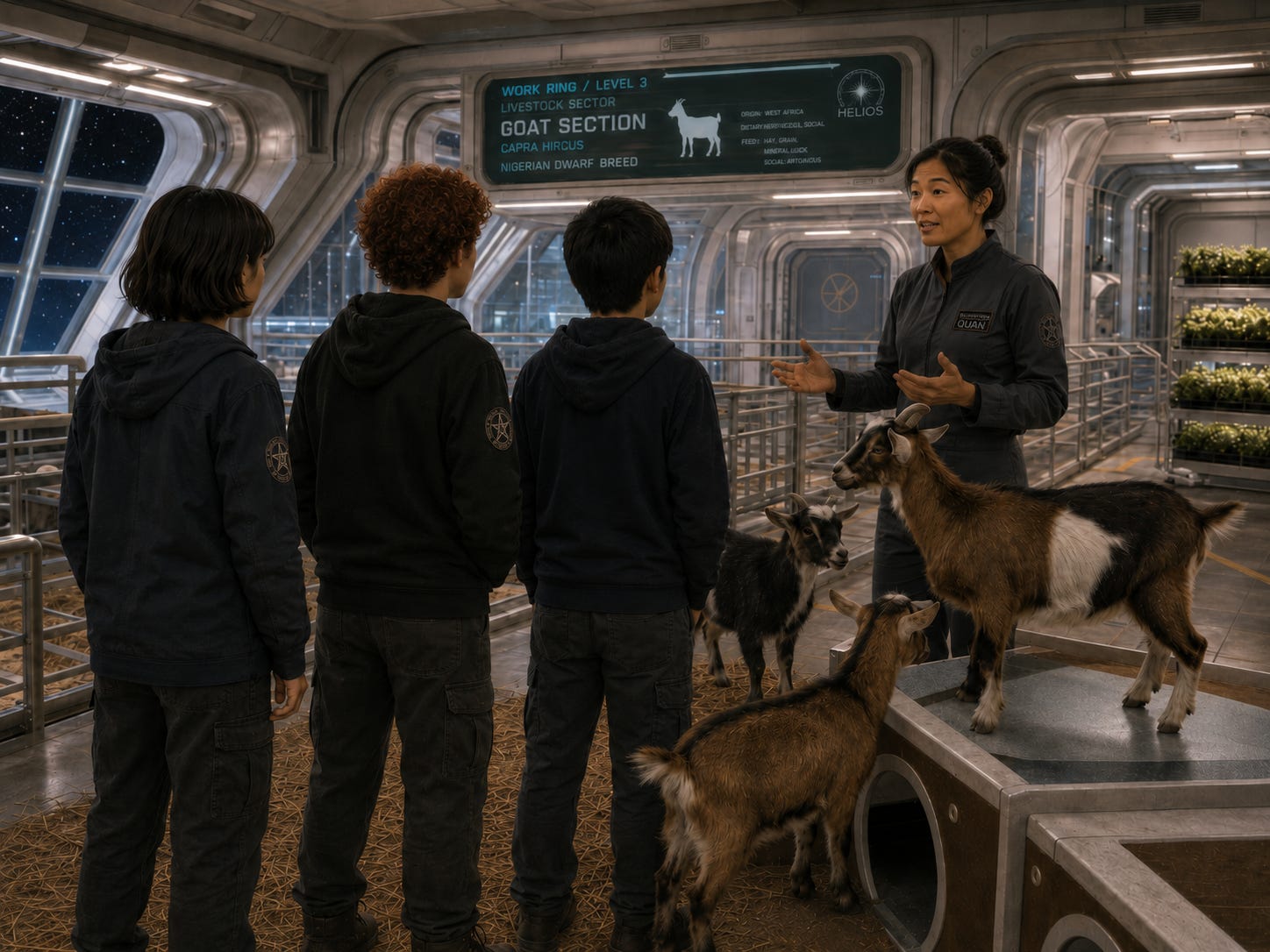
“Goats were among the first domesticated livestock animals,” Instructor Quan explained. “Probably around ten or eleven thousand years ago.”
Taro raised his hand.
“What was the first domesticated animal?”
“Dogs,” she replied. “At least fifteen thousand years ago, though some genetic evidence suggests divergence from wolves may have occurred between twenty and forty thousand years ago.”
“That’s a tragedy,” Darius said.
Instructor Quan looked at him curiously. “Domestication?”
“No,” he replied. “That we have to learn all of this again.”
Taro laughed, but Instructor Quan remained calm.
“What do you mean?”
“I mean, all of this was already learned by people before,” Darius said. “Now we have to learn it again, and then the next group, and the next. Isn’t that a tragedy?”
“It may feel that way, but it’s not a waste of time,” she said. “Relearning is what keeps knowledge alive. Every generation tests and reshapes the knowledge it inherits.”
Darius and Taro exchanged a glance, quietly absorbing the thought.
“To keep knowledge alive, we built archives, schools, libraries, and systems like Logminter. But knowledge only survives when someone learns it and chooses to carry it forward.”
I stopped paying attention after that because I stepped backward into something soft.
Very soft.
I looked down.
“Shit!”
Darius immediately pointed at the ground.
“You mean goatshit.”
Everyone burst out laughing.
Instructor Quan tried not to laugh.
I wanted to disappear.
Taro’s face changed. He asked one of the Terra Arc workers for something to clean it, while Darius helped me scrape my shoe against the edge of the walkway.
I was still embarrassed, but somehow it did not feel terrible anymore.
> I think that was the moment I realized we would stay friends forever…
Kyla stopped reading and started to cry. She could not help herself. The crying became louder.
From the bed, Julian’s voice broke the silence.
“You need your sleep,” he said softly. “You have been reading log entries all night. It is four in the morning. Come on, come to bed.”
She broke down completely.
“I cannot believe he’s gone.”
Julian stood and crossed the cabin. He held her while she cried against his chest.
“Tomorrow will be a tough day,” he said quietly. “Let’s try to get some rest.”
Subscribe to receive new posts.
###
A beep interrupted the silence of the morning.
“Computer, cancel alarm,” Julian said.
He turned over and closed his eyes for what felt like only a few minutes. Then he woke suddenly, realizing he had overslept.
“Kyla, we’re late. Computer, check my schedule for today.”
“Today is Wednesday. Year twenty-seven eighty-six. Day ninety-six. Zero eight forty-two hours.”
The numbers glowed softly on the nightstand:
2786.096.0842
“You have a call at ten thirty with the Regulation Bureau Director and a medical appointment at thirteen hundred hours.”
The cabin remained dim except for the pale light of the nightstand display.
“Please postpone both,” Julian said. “We have to go to the Council chamber.”
“I need a cold shower and a cup of black tea or something stronger,” Kyla said.
“Go ahead. Get ready, and I’ll take care of breakfast. I’ll make your favorite toasted bread with butter. I think we still have some.”
Julian went to the kitchen and started making breakfast. The aroma of dandelion coffee and toasted bread slowly filled the cabin.
He called from the kitchen, “Sweetie, you’ll have both coffee and black tea.”
“Thank you,” Kyla said. “Do me a favor. Taro wanted to talk before the Council session. Can you ask him if we can meet at nine forty-five?”
“I’m on it.” Julian’s Whisperzend light pulsed green as the call connected.
Thanks for reading Kyla’s Diary, a novel from the Theogenic Universe. New chapters will be published weekly. Subscribe to continue the journey aboard Helios.